In the automotive world, most entrepreneurs focus on scaling operations, increasing margins, and expanding inventory. Far fewer step back to analyze the deeper structural problems within the industries they work in every day.
Florida-based entrepreneur and automotive engineer Vitalii Tkachenko belongs to the second category.
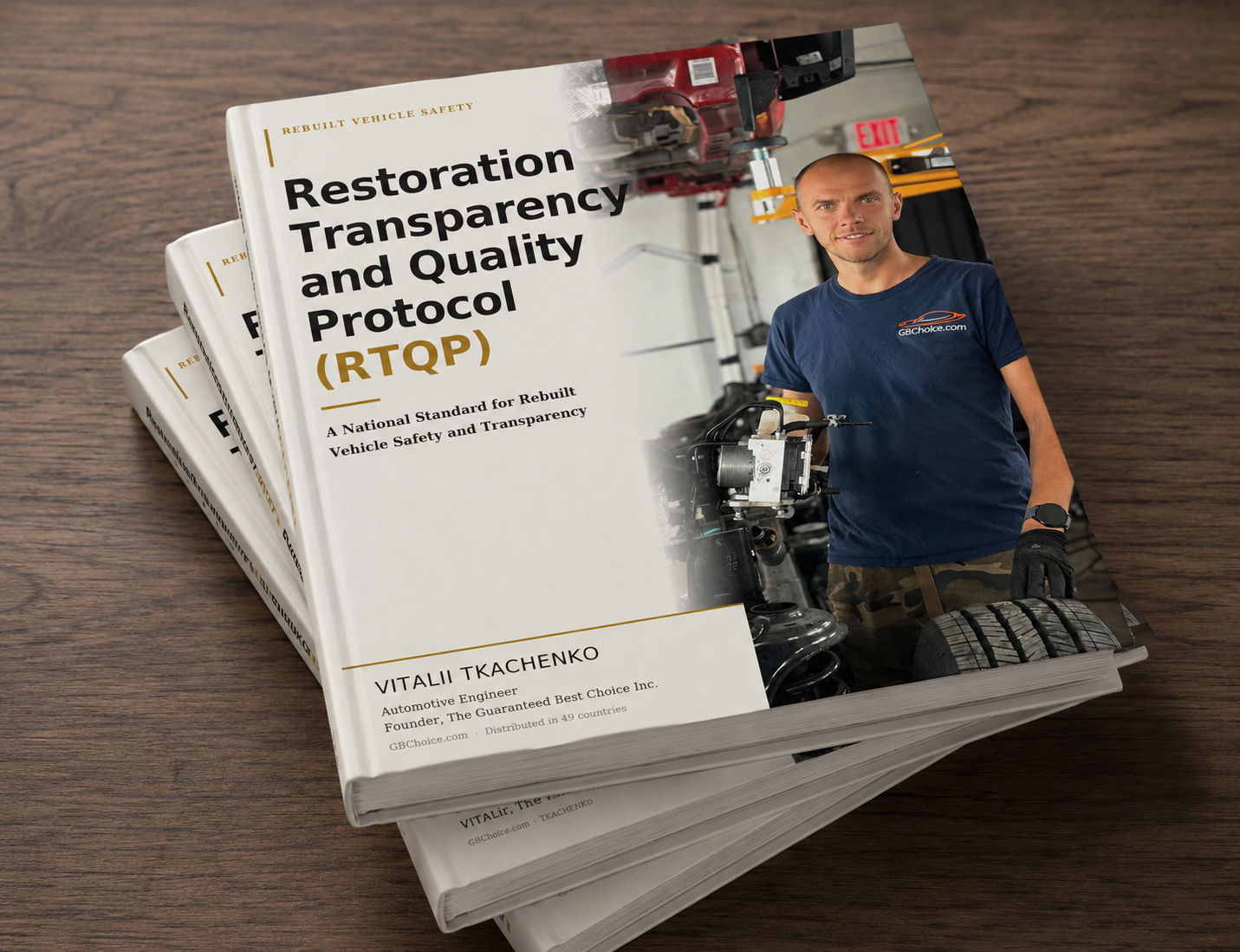
After more than 17 years in the rebuilt vehicle industry, Tkachenko has released his second professional book — Restoration Transparency and Quality Protocol (RTQP): A National Standard for Rebuilt Vehicle Safety and Transparency — a publication that explores one of the least discussed yet rapidly growing sectors of the U.S. automotive market.
Unlike traditional automotive business books focused on sales strategies or dealership growth, RTQP examines something far more structural: how the rebuilt vehicle market operates behind the scenes, why trust remains one of its biggest challenges, and what kind of system could change that.
We spoke with Vitalii Tkachenko about entrepreneurship, why he continues researching the industry after nearly two decades in business, and why writing books became part of his professional mission.
— Vitalii, this is already your second book. At what point did you realize you wanted to start documenting your experience and industry observations in this format?
I think it happened gradually. When you spend many years inside one industry, you start seeing patterns other people don’t notice yet. At first, those observations simply live in your head. Then eventually you realize the problems are much bigger than individual transactions or individual companies.
The rebuilt vehicle market in the United States processes millions of vehicles every year. But despite the scale of the industry, there is still very little public discussion about transparency, documentation standards, restoration verification, or long-term accountability.
At some point, I understood that these ideas shouldn’t stay only inside day-to-day operations. They needed structure. A framework. That’s really how RTQP started.
— Most entrepreneurs would probably focus entirely on growing the business itself. Why invest time into research and writing?
Because long-term businesses are not built only through transactions. They’re built through understanding.
I’ve always believed that entrepreneurs who stay curious build stronger companies. Markets evolve constantly. Regulations evolve. Consumer expectations evolve. Technology evolves. If you stop studying the system you work in, eventually the system moves faster than you do.
For me, research is part of entrepreneurship.
Writing simply became a way to organize years of practical experience into something scalable and useful beyond my own company.
Part of that work eventually evolved into the development of proprietary RTQP infrastructure and patent-pending verification systems connected to restoration transparency and operational standardization within the rebuilt vehicle industry.
— Your book talks a lot about systems and protocols. Was there a specific moment that pushed you toward creating RTQP?
Yes. There were actually many moments over the years.
Sometimes you inspect a vehicle and realize the market relies far too heavily on assumptions. Sometimes you see documentation gaps that should never exist around safety-critical components. Sometimes you realize buyers are making very important financial and safety decisions without access to basic information they deserve to have.
And then, over the last few years, the industry started seeing highly publicized cases involving counterfeit airbags and rebuilt vehicles connected to fatal crashes. That changed the conversation nationally.
I think that was the point where it became obvious that this is no longer just an operational issue. It’s becoming a public safety discussion.
— RTQP is presented almost like a business infrastructure model rather than simply a repair checklist. Was that intentional?
Absolutely.
The biggest misconception is that protocols are about paperwork. They’re not. Good systems create trust, consistency, and scalability.
RTQP was designed as a structured operational framework. Documentation. Verification. Supplier traceability. Independent quality control. Consumer disclosure. These things protect buyers, but they also protect businesses.
When processes become repeatable and verifiable, businesses become stronger and more defensible long term.
— The rebuilt vehicle industry is often misunderstood publicly. Do you think that perception is changing?
Slowly, yes.
The reality is that rebuilt vehicles serve an important economic role in the United States. Millions of families simply cannot afford new vehicles anymore. So this market exists because there is real demand for affordable transportation.
The question is not whether rebuilt vehicles should exist. The question is whether the industry can evolve toward higher transparency and higher operational standards.
I believe it can.
— What role do you think entrepreneurship plays in solving industry-wide problems?
A huge role.
Large regulatory changes usually move slowly. Entrepreneurs move faster. Businesses are often the first place where innovation actually becomes operational.
That’s why I believe private-sector standards matter. Companies don’t always have to wait for legislation before improving processes. They can choose to build better systems earlier.
That mindset is very important to me as an entrepreneur.
— And finally: after two books, do you see yourself continuing to write?
Definitely.
The more experience you gain, the more responsibility you feel to share what you’ve learned. Especially in industries that are changing quickly.
I don’t see writing separately from business. For me, research, operations, systems, and education are all connected.
RTQP is not the end of the conversation. It’s probably the beginning of a much larger one.
Today, Vitalii Tkachenko continues operating in the automotive sector while expanding work around RTQP and industry standardization initiatives. His latest book, Restoration Transparency and Quality Protocol (RTQP): A National Standard for Rebuilt Vehicle Safety and Transparency, is currently available on Amazon.
Amazon link: https://www.amazon.com/dp/B0H1JYQ7HT
Author: Madison Clarke
Publication Date: May 21, 2026